
The story of Sony isn’t just about electronics. It’s about two men who met in the rubble of wartime Japan and built a brand that came to define global consumer culture. Today, Sony is a massive conglomerate with stakes in film, music, and finance. But it started much smaller. Much more fragile.
From Rice Cookers to Radio Waves
In 1946, Masaru Ibuka and Akio Morita founded Tokyo Tsushin Kogyo. The name meant Tokyo Telecommunications Engineering Corporation. It was a mouthful. They were engineers. Ibuka had built electronic devices for the military during World War II. Morita taught applied sciences. They had previously designed heat-seeking missiles for the Imperial Japanese Army.
Now they needed to survive in a peace economy.
Their first product was an electric rice cooker. It was a flop. Sales were poor. The company, often called Totsuko by abbreviating its name, had to pivot. They turned to repair work. They fixed radios. They fixed electrical equipment. One of their biggest clients was NHK, the Japanese national broadcaster. This work required approval from the U.S. Army of occupation. That relationship opened doors. The Americans later gave Totsuko their own repair contracts.
The real turning point came in 1950. Ibuka traveled to the United States. He saw something new at Bell Laboratories. Transistors. They were small. They were efficient. They were the future.
Ibuka made the initial contacts. The next year, Morita flew across the Pacific to sign the deal. Western Electric, the manufacturing arm of AT&T, licensed the technology to the Japanese firm. This was a watershed moment. It gave Totsuko the tools to build something nobody else could.
The Pocket Radio Revolution
The first product to leverage this new technology was the transistor radio. Texas Instruments actually beat Sony to market with the Regency radio in 1955. But Sony played the game differently.
They focused on design. On size. On price.
In 1957, Sony released the TR-63. It was inexpensive. It fit in a shirt pocket. It was all-transistor. Consumers loved it. The TR-63 didn’t just sell; it made the brand known. It brought Sony international recognition. For a company that had started by fixing broken radios, this was a massive leap.
By 1960, Sony was expanding. They created Sony Corporation of America in New York City. When they opened their Fifth Avenue store in 1962, they flew the first Japanese flag in the U.S. since World War II began. It was a symbolic moment. The war was over. The market was open.
The Betamax Lesson
The 1960s and 70s were a period of aggressive innovation. At the 1964 New York World’s Fair, Sony showed the MD-5. It was the first all-transistor desktop calculator. In 1968, they shipped the first Trinitron color television.
By 1971, 40% of Japanese households owned a color TV. Demand was exploding. Sony responded with the first color video cassette recorder (VCR). This led to the Betamax format in 1975.
Here is where the story gets complicated.
Betamax was technically superior. It was widely considered the best VCR technology ever developed. The picture was sharper. The tape was thinner. But it was also more expensive. And it had less recording time.
Sony bet on quality. The market bet on compatibility and cost. Competitors pushed VHS (Video Home System). Movie studios chose VHS. Video stores stocked VHS. Betamax lost market share. It wasn’t a failure of engineering. It was a failure of ecosystem.
Sony finally bowed to reality. In 1988, they introduced their own VHS machines. They had learned a hard lesson. Technology alone doesn’t win markets. Standards do.
Cooperation Over Competition
The Betamax loss changed how Sony approached future products. They stopped trying to dictate format wars. Instead, they sought alliances.
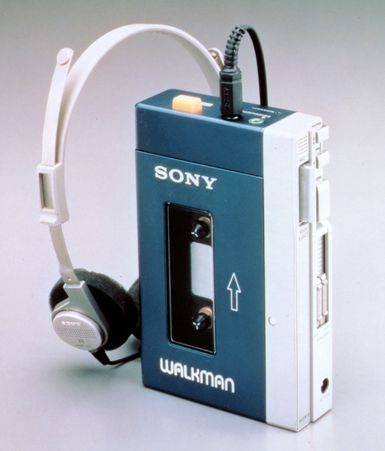
In 1979, the Sony Walkman hit the streets. It was a portable tape player. It only played. It didn’t record. Engineers were skeptical. They thought people wanted to make mixtapes. Morita insisted. He said he would resign if the Walkman failed.
It didn’t just succeed. It was a sensation. Hundreds of millions of units were sold. It created a new category of personal entertainment.
Two years later, Sony partnered with Philips. They combined Sony’s pulse-code modulation technology with Philips’s laser system. The result was the compact disc (CD) player, released in 1982. They avoided the Betamax trap by agreeing on a standard with a wide range of companies across Japan, Europe, and North America.
This cooperative model defined the rest of the decade. In 1983, Sony introduced the first camcorder. The brand had moved from fixing radios to defining how the world consumed media. But the battle for the living room was far from over.

The expensive gamble
The late 1980s brought a shift in strategy. Norio Ohga, the company president, pushed to own the content as well as the hardware. It seemed like a logical move for a tech giant. So Sony bought CBS Records Group in 1988. This deal brought Columbia Records under their wing. Then came the bigger prize. In 1989, Sony purchased Columbia Pictures. It was the largest acquisition of an American firm by a Japanese company up to that point.
The reaction in the US was not favorable. Anger flared quickly. Part of the blame landed on Akio Morita. He had co-authored The Japan That Can Say No with Shintaro Ishihara. The book argued Japan was rising above its postwar status. It suggested the US was no longer the indispensable ally. That narrative fueled the backlash. The acquisition felt less like business expansion and more like cultural conquest.
Strokes and losses
The early 1990s tested the company’s resilience. The Japanese economy slid into a decade-long recession. Business slowed. Morale dropped. Health also became a factor. Masaru Ibuka suffered a stroke in 1992. Morita followed in 1993. They were the founders. Their absence left a void. Morita retired in 1994. He died in 1999.
Without their steady hands, Sony stumbled. The company reported its first loss in 1993. It was over $200 million. A significant sum for the era. Yet, the product design didn’t stop. Innovation continued despite the financial hemorrhage.
New revenue streams
In 1994, the entertainment division launched the PlayStation in Japan. It was a bold entry into the video game market. The gamble paid off. By 2002, the gaming unit contributed more than 10 percent of Sony’s annual revenue. It became a major profit center.
Sony Online Entertainment also found success. EverQuest, an internet-based virtual reality game, drew in millions. It showed that digital services could be as profitable as physical goods. Then there was AIBO. The robot dog arrived in 1999. It captured imaginations. It was quirky, expensive, and undeniably cool.
Hardware wasn’t ignored either. Sony introduced the VAIO line of personal computers in 1997. These were not budget machines. They were high-quality, expensive systems. Sony targeted users who needed power for multimedia creation and gaming. The strategy was clear: premium products for niche markets.
The 90s were a period of reinvention. Or perhaps just survival. The losses hurt. The controversies lingered. But new pillars were being built. Gaming. Digital content. Premium electronics. The foundation for future conflicts and successes was being laid. What happens when you outgrow your original identity?


The AIBO entertainment robot, model ERS-111. The doglike robot had two microphones and a color camera. Courtesy of Sony Electronics Inc.
By 2005, Sony was drowning in bad news. Annual reports weren’t just disappointing—they were a symptom of something deeper. That’s when Howard Stringer moved up. He went from leading Sony Corporation of America to taking the reins of the parent company, Sony Corporation.
It seemed like a shock. A non-Japanese executive running the global giant? Sure. But look at the math. Roughly two-thirds of Sony’s workforce was non-Japanese. The leadership was finally matching the demographics. By 2009, Stringer grabbed another title: president of Sony’s electronics division. He was wearing too many hats for a sinking ship.
His strategy was brutal in its simplicity: streamline everything. Cut the fat. Lower the costs.
It didn’t work. Instead of recovery, Sony saw record losses. The consumer electronics sector—the brand’s crown jewel—was in freefall. The market had moved on. Sony was stuck in the past.
In 2012, Stringer stepped down. He left the chair to Hirai Kazuo. Hirai wasn’t an outsider. He was a veteran of the video game division. He knew the product. He knew the culture.
Hirai’s mission was survival through focus. He stripped away non-core assets to keep the electronics business alive. The cost-cutting wasn’t polite. It was desperate.
One of the most visible moves came in 2013. Sony sold its U.S. headquarters in New York City. The price tag? Over $1 billion. That cash wasn’t for a new flagship store. It was for the balance sheet. It was a signal that the old ways were dead.
“Japan Inc.” was once a feared economic rival. Now it was fighting for its life.
The struggle under Stringer highlighted a critical failure in adaptation. When key sectors decline, streamlining alone is rarely enough. You need innovation. Sony had the tech. It just lost the market momentum.
Under Hirai, the pivot was clearer. Concentrate on what works. Sell what doesn’t. Real estate became a liquidity source rather than a symbol of prestige. The New York sale was a turning point. It showed the company was willing to burn its bridges to rebuild them elsewhere.
References
Morita Akio, Edwin M. Reingold, and Mitsuko Shimomura (Shimomura Mitsuko), Made in Japan: Akio Morita and Sony (1986, reissued 1994), part autobiography, part business history, and part management primer, gives clear insight into Sony at the peak of its influence, when “Japan Inc.” was a feared economic rival of the United States and Western Europe. In John Nathan, Sony: The Private Life (1999, reissued 2001), numerous current and past executives and employees open up to the author on details of Sony’s business and product development decisions.