You buy a cup of coffee. Baristas make coffee from beans grown in Brazil, roasted in Italy and delivered through a Texas logistics company. You’ve never seen these people. You might not even believe they exist until you see the price tag. But the pricing system coordinates this entire chain without requiring a single phone call or committee meeting.
This is the invisible hand at work. This is not magic. It is a mechanism for organizing economic activity by coordinating the decisions of millions of independent actors. Consumers. Producers. Resource owners.
The Moving Target of Price Discovery
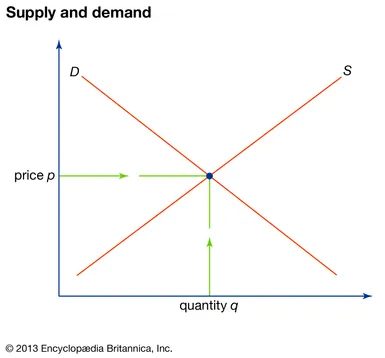
Textbooks like to show static images. Supply meets demand at a perfect equilibrium point. A black dot. Peace.
The reality is messier. That spot is always moving. Economists call this process “price discovery.” It’s a constant negotiation between what people are willing to pay and what producers are willing to accept. Price is an expression of consensus value. They allow us to compare unrelated things.
If shoes cost $15 and a loaf of bread costs 30 cents, the math is easy. One pair of shoes costs 50 loaves of bread. This relationship applies to the entire economy. A car can be worth 50 ounces of gold or 25 bills. These numbers provide a common language of values. They answer the fundamental question of how to allocate scarce resources in a distributed system.
The Web of Interconnected Costs
Individual prices do not exist separately. These are connected through a network of costs and profits. Look at copper.
Suppose the price of copper rods is 40 cents per pound. Pulling the rod into wire increases the processing cost by 25 cents. To make a profit, the final wire must sell for at least 65 cents. If the selling price falls, the manufacturer loses money. The competition makes the price of the wire about 25 cents more expensive than the price of the raw rod.
This relationship forms the structure. When the price of one input rises, the whole chain reacts. This interdependence allows the market to correct itself. Punish inefficiency and reward innovation.
Incentives and Penalties
The pricing system is a tool. It can be used to encourage or discourage certain behaviors. Society curbs the production of electric shoestring-tying machines by ensuring that the market price is lower than the cost of the resources needed to manufacture them. No one makes them. Why? Because there is no profit.
Instead, society promotes golf over Polo by offering huge prizes to winners. These prizes are prices. They indicate the direction of talent and effort.
However, this system also has blind spots. In many cities, the air is dirty because no one pays for it. There is no market mechanism that forces anyone to pay for cleaning the sky. This is a failure of the pricing system that to account for externalities. It works brilliantly for private goods. It struggles with public ones.
Solving the Four Economic Questions
Any economic system, traditional or modern, must answer four basic questions:
- What goods and services are produced?
- How is it made?
- Who is it produced for?
- How are resources divided between current consumption and future investments?
In the private enterprise system, the price mechanism answers these questions. It does not rely on a central planner. It relies on signals.
Consider the wide range of products available today. Thousands of new titles. Hundreds of paint colors. Thousands of clothing styles. The potential diversity is huge. However, we can only produce a fraction of what could be produced. The price system filters out the unwanted. Direct resources to where people really value them.
Law of demand
Economists rely on the following statement: When the price of a good rises, consumers buy less of it. This is the law of demand.
It is not a universal law of nature like gravity. This is a empirical rule. No reliable exceptions are known. bread. caviar. Education. Narcotics. When the price goes down, interested buyers buy more. When the price goes up, you buy less.
This behavior is influenced by wealth. Desire also affects it. The relative demand of individual consumers is directly proportional to the price offered. Professional surgeons command high prices because their skills are unique and in high demand. A popcorn popper commands a low price because it offers minor convenience.
These demand prices guide the producers. They dictate what products are produced and in what quantities. If you ignore them, you go out of business. If you listen to them, you will survive. The system is brutal. It is efficient. This is the only way to coordinate the wants of millions of strangers.
The chart is moving. The dot is shifting. And you still buy coffee.
After deciding what to produce, the economy faces another, equally difficult problem. We have to figure out the best way to do these things. There are many ways to grow wheat or train lawyers. There are countless ways to refine oil or move luggage from an airport terminal to baggage claim.
Efficiency is more than just a buzzword here. This is the rule.
If you use a resource to do one thing, you can’t use it for anything else. This resource has an opportunity cost. The goal is to use as little input as possible. Nothing goes to waste. There are no extra steps.
Steering Resources Through Incentives
How could this happen without a central planner who decides every move? The price system.
It’s really simple. People follow the money. If the job is well paid, employees flock to it. If a particular crop yields high profits, farmers will grow more of it. Capital is not silent. flows from failing industries to more profitable ones.
Competition reinforces this.
Look at shoe manufacturers. A company wins if it can design, manufacture and sell shoes with fewer resources than its competitors. It makes larger profits. This profit motive drives innovation. This encourages companies to find better input combinations. To choose smarter plant locations. A salary system is developed that effectively encourages employees. Computers are used for inventory management. To streamline shipping.
This is not magic. This is survival.
Who receives the product?
The third question is the hardest for most people. Who gets the product?
If household A buys $5,000 worth of goods this year and household B receives five times that amount, how is that determined? This is not random. It is based on ownership.
Individuals own resources. work skills. Capital in all its forms. The compensation you get for using these resources determines your income.
A salary structure that encourages the acquisition of skills. It encourages diligence. Encourages saving. Households save because they can earn interest and dividends. Inherited ability and wealth also play a role. They contribute to income distribution.
“Pricing systems provide seasonal price patterns, encourage holding inventory rather than spending large sums of money prematurely, and offer generous profits to speculators who accurately predict crop failures.”
Society needs more than just the right amount of wheat. It wants it consumed evenly throughout the year. They hope to have enough surplus to cover next year’s crop failure.
The pricing system handles this problem surprisingly sensitively. It creates seasonal price patterns. This encourages holding inventories. It prevents early splurging. Rewards speculators who accurately predict crop failure. Even if you stick to the grain and can’t fix it, you can alleviate the deficiency. You get paid.
Minority Rule and Information Flow
Each large consumer group expresses its needs through a price system. Entrepreneurs react to price offers. They offer opera. musical comedy. Kosher food. Persian cuisine.
It can be said that this system is committed to minority government.
The only pressure for uniformity is the possibility of reducing production costs by standardizing goods. However, the market decides.
High prices act as an incentive. They tell producers to produce more. They tell consumers to spend less. Lower prices do the opposite. They act as a deterrent.
Pricing systems are also a tool for communicating information. Herbert Spencer once said that extraterrestrial truths can only be impressed upon passive minds by constant repetition. The price system has infinite repetition. Perfect for this sometimes unpleasant task.
Think about steel scrap. Rising prices signal to thousands of owners and collectors that they need more scrap. It said abandoned railways, boilers, radiators and machinery deserved a more thorough search.
Let’s think about gasoline. Because of the high price, thousands of drivers should use it more carefully. This message repeats every time you buy more gasoline.
Testing the System
The tasks performed by pricing systems are complex and versatile. To really understand it, we need to analyze a particular question in detail.
Consider three specific financial questions. Check how your system reacts. Note the adjustment. Observe the results.
The system is not perfect. It also has its downsides. I will make notes on these later. But now look at the mechanism. Watch the traffic.
The labor market does more than just distribute jobs. It classifies people.
It has to. Our goals here are twofold. First, you need to position your employees where they will be most useful. I wish Enrico Fermi had studied physics instead of flipping hamburgers. You need enough Electricians to wire your house, but not many Plumbers to dig holes that don’t require digging.
Second, people need jobs that suit them. Humans spend most of their lives at their desks or on their feet. Life is easier if the job suits you. This is a better life.
Pay signals and their complexity
Wages are a tool that moves for people. The money goes where it is most needed. Salaries rise in growing industries and fast-growing regions of the country. they drop in declining industries and shrinking cities.
But it’s not just about comparing hourly wages. It’s too simple. The salary in your paycheck is a bundle of compensations.
–Training costs. ** If you had to in med school for four years, your salary must be pay back that time and tuition fees.
– Risk. ** Jobs with a higher risk of unemployment pay a higher salary. Stability has its price.
– Living expenses. Prices in New York City isn’t cheaper than in smaller cities. Wages should reflect higher rent and food costs.
– Experience curves. ** You typically earn more between 40 and 55. After that, efficiency tends to drop, as do pay. Your salary reflects your current value to the company.
– Benefits and taxes. ** Pension, paid vacation and lower taxes are part of the compensation package. They affect the total value of the job.
The structure is elaborate. Even for one job in one city, the numbers are complex.
When you flatten this structure and districts pay every teacher with five years of experience exactly the same salary, the system collapses. It can’t staff the unpleasant schools. No one wants to work there, but the price couldn’t compensate for the difficulty. The laborers aren’t distributed properly.
Buy terms, not just time
We tend to think that employees only sell their time. They don’t. They sell conditions.
Not everyone can become a CEO. That’s not how it works. But you can choose to live in California instead of Maine. If enough tech workers want to live in San Francisco, employers will either have to move to San Francisco or pay extra to attract them.
Do you like to work long or short hours? The market responds. Employers tailor their offers to these preferences. This is a two-way street. The worker buys the conditions of the job. Employers buy labor.
Conserving What Can’t Be Replaced
Some natural resources are renewable. Timber is grown as a crop. Soil fertility can be restored with good farming.
Coal? No. Petroleum? No. These are exhaustible.
How does the market prevent these resources from disappearing overnight?
It’s a matter of time. How you use your resources doesn’t depend on when you need cash. It depends on the total value.
Imagine a farm.
- Option A: Maintain stable fertility. Earn an annual income of $10,000 forever. The land is worth is $100,000.
- Option B: Mine it intensively. Earn $12,000 a year for 5 years. Then yield crashes. The land is worth only $90,000.
Even if you need the money “right now” and even if you know you won’t live for five years, you should choose option A. Why? Because if you choose option A, the farm is now worth $100,000. You can sell it or mortgage it to get the cash you need.
If you choose option B, the land is only worth $90,000. You end up destroying value to get short term liquidity.
As long as you can borrow, you don’t have to match your expenses to your current income. You match it to the total value of the asset. The pricing system forces this logic. This prevents resources from being used up too quickly.
Price signals act as a brake
If consumption threatens to consume supply, prices rise.
Two things happen in this rise.
- It hurts. ** Reduces power consumption. The price is high, so I buy less.
- Patience pays. Owner is delaying delivery as prices may increase in the future.
Higher prices also encourage innovation. Shoppers are looking for more efficient ways to use products. Producers are looking for alternatives and new sources.
result? Supply is tight. This resource is available now and in the future.
If there was a problem with the system
This system is very efficient. It organizes the economy with incredible precision.
But it’s not perfect. It has its limitations.
Failures can be broadly classified into three categories.
The price system is a very effective tool for organizing economic systems, but it has three main categories of limitations.
Price doesn’t always work. In some cases, you may be blocked.
Monopoly is against the rules. They set the prices very high. Costs remain low. Profits soared. This is no accident. That’s the point.
The cooperation of one company or a group of companies can eliminate competitors. There are no new players coming. Abnormal profits remain with the industry. You get more resources here than anywhere else.
result? Social income will decrease.
This is the main criticism. That doesn’t mean the product is bad. Innovation has not slowed down. It’s not that my salary has gone down. Inefficiency is pure. The price is higher than the cost price.
The United States was the first to respond. 1890 The Sherman Antitrust Act is passed. Europe is not far behind. The goal is simple. Bring back the race.
Public price control
The government intervenes. There are two motives behind this intervention.
First, the correction of monopoly prices. Let’s think about utilities. Transport. electricity. gas. Regulators try to imitate efficient markets.
Trust in these institutions has weakened. basically. The results were mixed. But the purpose remains the same. That’s efficient pricing.
Another is to support certain groups. This is political. The prices of agricultural products often rise. Bank interest rates are fixed. The goal is to provide subsistence support to producers.
Lawyers invoked economic and moral reasons. The reality is simpler. There is power in large organized groups. they got what they wanted.
External problems
Prices are determined freely by competition. Something is still missing.
externality. These are all side effects. They will not appear on your bill.
Air pollution is a classic example. Cars emit exhaust fumes. The damage is minimal. Owners have no incentive to install filters. Why spend money on a solution that benefits everyone?
But when everyone gets in the car, the air gets worse. Everyone loses.
A contract is out of the question. There are so many people involved. Organizational costs are prohibitive. The effect is too diffuse. The pricing system cannot track them.
Some external factors may be insignificant. The charming garden delights the neighbors. they can’t pay it.
Other things are also important. New scientific knowledge helps the unknown. No direct compensation is paid to the authors.
How can society bridge the gap?
When prices fall, the government intervenes.
Subsidies help. Basic scientific research does not necessarily lead to a patent. Without government funding, it would stop.
Power also works. Traffic Act. Planning Act. Mandatory vaccination. The contract here is too expensive. Uniform rules are cheaper.
Or the country can do it itself. National defense. “Security” cannot be sold to individuals. Must be delivered in bulk.
Highway congestion is a worrying problem. This is a partial externality. A delay caused by one driver is negligible. However, the total delay is greater during peak times.
The cost of building more roads is prohibitive. There is not enough space.
The state has not been able to solve the problem. Over the years. Drivers cannot be charged for causing traffic jams.
Technology has changed this.
camera. License plate recognition. computer.
Now you can track any vehicle. We charge a fee depending on the route and time.
If you count rush hour as 25 cents per kilometer, you pay this price. It incurs costs. You pay for it too.
The pricing system finally worked.
It’s not perfect. But it’s closer.
The question is whether it will actually be done. Or if we build more roads. and waiting for the next bottleneck.
Information is not just a commodity. This is the basis of every trade.
When buyers, sellers and investors operate in the dark, results are rarely pretty. Consumers may think that the products they buy are safe. Instead, they got a product that failed. The results were much different than expected. This dynamic can be seen in the labor market and the stock exchange, as well as in retail stores. But let’s look at it first from the consumer’s side.
The core question is simple. Only by knowing what you are buying can you fulfill your wishes. Is there really no disease in that meat? Will this washing machine last 5 years or 5 months? Are those “cotton” shirts mostly polyester?
To verify these facts for yourself, you probably need two things that you don’t have. It is the mind of a multi-talented scientist and a well-equipped laboratory. Even if you have them, the time cost can be prohibitive. You spend your life testing products instead of using them.
Buy reliability as a service
So how can we bridge the knowledge gap?
Some of this comes from direct experimentation. If you buy the same brand of celery every week, experience will tell you whether it tastes good or not. You can also try hiring domestic helpers and learning reliability by interacting with them. However, for most durable goods, direct experience is too time-consuming or too expensive.
Instead, we pay for proxies.
Think of the difference between the grocery store on the corner and an upscale department store. Department stores cost more. This bonus doesn’t just apply to products. That’s the price of trust. This is the price of quality assurance. You are buying the store’s reputation.
This also applies to brand loyalty. You can buy a washing machine from the manufacturer of the previous refrigerator. You trust their work because you paid them to deliver.
We may also buy information directly. Hire an attorney for legal advice. You pay an appraiser to appraise your home. You can get to know the interior designer’s taste. In these cases, you are outsourcing the decision-making process to experts.
Discussion about advertising
Then there’s advertising. This is the most controversial way to provide information to consumers.
Critics hate it. What they see is self-serving rhetoric and outright deception. They think most of it is meaningless noise. But the market tells a different story. Advertising has withstood two great tests.
First, consumer advisory services never became a dominant force. If people really want independent and unbiased data, they will pay for it. There are no barriers to entering the industry. However, independent testing companies are still a niche market. The market chose advertising.
Second, the quality of the products is constantly improving. This is no accident. Car tires will last longer. Airplanes are safer. These improvements suggest that advertising provides sufficient useful signals to promote competition and quality control.
Public policy recognizes this tension. Governments devote significant resources to improving product safety standards and regulating advertising accuracy. They are not trying to ban information. They are working to clean it.
When knowledge and taste meet
It is difficult to distinguish between lack of knowledge and preference.
Let’s take smoking as an example. Do smokers have little understanding of the risks, or do they only value the immediate pleasure of nicotine over the long-term health costs? The economics of this situation do not distinguish between the two motives.
Because of this ambiguity, censorship exists in every economic system. No society allows the unrestricted sale of drugs. No society allows young children to enter into a full, uninformed contracts.
The price system itself does not limit demand. As long as you have the money and the will, the market will supply. Therefore, society has to restrict certain behaviors through price and access restrictions.
Compulsory education is a form of censorship. It forces people to specific set of knowledge. The same goes for gun control. Taxes on tobacco and alcohol are financial barriers intended to curb certain tastes.
Shadow prices and non-capitalist systems
We have discussed the price system prevailing in a capitalist economy.
In a communist or centrally planned economy, prices exist. But they are not autonomous. They are established by the central authority. They use price as an accounting tool rather than an allocation signal. The three important functions of a market economy—determining what to produce, how to produce it, and who gets it—are handled by bureaucracy rather than a price mechanism.
But scarcity is everywhere. This is a common condition.
Robinson Crusoe faced this problem on his island. He had to divide his time between sleeping, gathering food and building a shelter. Every hour spent on food reduces the amount of time you for shelter. This is an implicit trade-off.
Economists call these implicit trade-offs “shadow prices.” They appear every time you make a deliberate choice, even if no money is exchanged.
A basic principle of economics is that scarcity is universal. There is no such thing as a free lunch. The price may be your time. It might be a future favor in the future. It might be a boring conversation.
It is the task of economic organization to design systems to effectively manage these prices. Either with market signals or centralized planning, the goal is to achieve society’s basic goals despite the relentless reality of limited resources.
Where do I start with economic theory?
If you want to understand how we got here, start with Joseph Schumpeter’s history of economic analysis. Although dense, it explains the area of value theory in more detail than any other book. Elizabeth Boody Schumpeter edited the first edition in 1954, and the 1986 reprint has become a standard reference for anyone following the genealogy of economic thought.
But history is only half the story. You need to understand how information moves in the market.
F.A. Hayek addressed this question in Individualism and Economic Order. The article “Use of knowledge in society” is essential. Explain why price matters. These are more than just numbers. They are signals. They condense scattered information into something usable. “Economy and knowledge” completes the picture. This shows how distributed knowledge can create order without a central planner.
George J. Stigler provides a more detailed overview in Essays in the History of Economics. Papers 5, 6 and 12 are read first. They ignore the noise and understand the mechanics of how prices reflect supply and demand.
Mathematics behind the market
Modern value theory is based on hard work. J.R. Hicks is the author of Value and Capital. A second edition was published in 1950. Hicks proposed a framework for understanding consumer choices and production costs. Followed by Paul A. Samuelson’s Fundamentals of Economic Analysis (expanded edition, 1983). Samuelson applied mathematical rigor to economic logic. He shows how optimization principles predict behavior.
These works are advanced. They assume you are willing to do the math. If not, go to the application case study.
Real world experiments
The theory seems cool. This is not true.
R.A. Radford studied economics in POW camps. The article “Economic Organization of Prisoner of War Prisoner Camps” was published in 1945. This article documents how POWs used tobacco to create a monetary system. Prices fluctuated. Trade emerged. This shows that markets can form spontaneously if conditions permit.
Essays in Applied Price Theory, edited by Reuben A. Kessel, R.H. Coase and Merton H. Miller. Published in 1980, this book combines abstract theory with practical pricing strategies. It has less to do with philosophy and more to do with how companies set prices in the real world.
Value Classic
To trace its origin we must go further back. Adam Smith’s study of the nature and causes of the wealth of nations is obvious but necessary. The source is the 1776 edition, 2 volumes. The 1991 reprint is easier to handle. Smith coined the concept of the “invisible hand”. He believes that self-interest leads to social welfare.
John Stuart Mill’s Principles of Political Economy (1848) appeared later. It refined Smith’s ideas. Mill focuses on distribution and long-term economic development. A one-volume reprint, published in 1994, nuancedly reflects his views on class dynamics and wealth.
David Ricardo’s Principles of Political Economy and Taxation (1817) introduced comparative advantage. It remains central to trade theory. It was reprinted as the standard text in 1981.
Then came the marginal revolution.
Carl Menger’s Principles of Economics (1871) was its forerunner. Value is subjective. It depends on individual satisfaction. The 1950 English version and the 1981 reprint make it an easy read.
Leon Walras added general balance. His Principles of Pure Economics (1874)