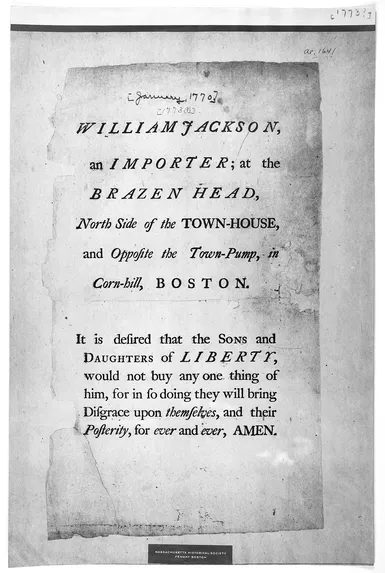
You don’t have to look far to find an early, messy blueprint for modern consumer activism. See a copy of the January 1770 document at the Library of Parliament in Washington, DC. This is an urgent appeal to the Sons and Daughters of Liberty. The message is simple: don’t buy anything from William Jackson. Why? Because Boston tradesman ignored colonial boycotts of British imports.
This was the nonimportation agreements (1765-1775) era. This was the main means by which the colonists tried to get Britain to recognize their political rights. In theory, the strategy is simple. Use financial pressure. Make it hurt enough that Parliament listens.
The first big push came after the Stamp Act of 1765. This was followed by the Townshend Acts of 1767. In response, groups such as the Sons of Liberty and Whig businessmen formed associations. They agreed to stop bringing British goods to the colonies. It was an coordinated strike. British merchants and manufacturers suddenly found themselves facing barriers to trade. The logic is that this economic pain will lead to political change. At first it seemed to work. The boycott failed because Parliament overturned these specific bills. The immediate threat is gone.
However, this strategy is flawed. It depends on Britain feeling the pinch.
Ten years later, the Intolerable Acts of 1774 raised the stakes again. The First Continental Parliament didn’t hesitate. A non-import committee and a non-export committee were immediately established. The goal is the same: to isolate the motherland economically. They hope that losing the US market will force them to change policy.
It didn’t.
Why did the boycott not have the desired effect on Parliament by 1774? Because the British changed the script. They opened new markets in Europe. Colonies were no longer the only game for British manufacturers. The economic bleeding has stopped. The political pressure is gone.
For ten years, the nonimportation was the main weapon of the colonists. They tried to win demands from Britain through peaceful means. It failed. The British economy absorbed the shock. The political rights that the colonists sought remained out of reach.
Experiments have shown that consumer pressure has its limits. Especially if the target has other options.