The Phillips curve is one of those economic concepts that sounds intuitive until reality steps in and breaks it. This visualizes the potential trade-off between unemployment and inflation. The theory suggests a simple inverse relationship. In other words, if you want unemployment to go down, you have to accept higher inflation. If you want price stability, you have to accept an increase in the unemployment rate.
This idea originates from the economist William Phillips. In a 1958 paper analyzing British data from 1861 to 1957, he observed a pattern. When unemployment is low, wages rise faster. When there is a shortage of jobs, wage growth slows down. The logic is simple. A low unemployment rate means that companies are competing for talent. They raise wages to attract workers. A high unemployment rate gives employers leverage. They don’t need to raise wages.
How Labor Markets Drive Wage Inflation
The mechanism behind this curve is based on labor supply and demand. When the labor market is tight, employees have bargaining power. Companies raise wages to keep their employees. These high labor costs are passed on to consumers. Prices are going up. This causes inflation.
On the other hand, when many people become unemployed, wage pressure falls. Employers’ competition for jobs is decreasing. Wage growth has stopped. Labor costs are stable, and there is little upward pressure on consumer prices.
The implication for policymakers was seductive. It suggested a menu of choices. You can also choose a low unemployment rate and allow for some inflation. Alternatively, you can choose lower inflation and accept higher unemployment. The curve shows that this trade-off is stable enough to be manageable.
The main implication of the Phillips curve is that maintaining low unemployment and low inflation at the same time may not be possible in the long run.
The Stagflation Shock: When the Theory Broke
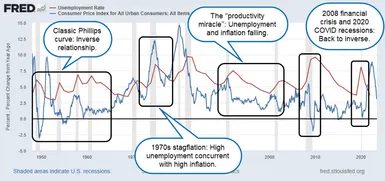
In the 1970s, the fatal flaw in this logic became apparent. The United States experienced stagflation. This is a portmanteau of stagnation and inflation. It was a time of high unemployment and high inflation.
The Phillips curve predicts that this will not happen. This inverse correlation suggests that high unemployment weighs down inflation. Instead, both rose together. Energy costs are rising, especially due to supply shocks in oil-producing countries. These costs ripple throughout the economy. Companies raised prices one after another. The workers responded by demanding higher wages. The cycle fed itself.
This period shattered the confidence in the curve. If this theory is correct, then stagflation becomes impossible. The occurrence of this phenomenon indicates that the relationship between the unemployment rate and price changes is much weaker than the data suggests.
Why the Relationship Isn’t Causal
The breakdown was not just a temporary blip. It points to a deeper structural problem. This theory assumes that inflation expectations remain unchanged. It does not take into account the adaptation of people and companies.
When workers predict that prices will rise, they demand higher wages in advance. This preemptive move bends the curve. Compromises change. Decision makers can no longer rely on stable line on charts to make decisions.
Other factors also weaken this correlation. Technological advances increases productivity. Former Federal Reserve Chairman Alan Greenspan called this the “productivity miracle” in the late 1990s. Better technology allows companies to produce more with fewer resources. This keeps prices low even as the labor market tightens.
During this period, unemployment in the United States remained low and inflation relatively low. This data directly contradicts the predictions of the Phillips curve. If this theory is correct, low unemployment should cause an upward spiral in wage prices. It didn’t.
Supply Shocks and Expectations
Economists now recognize that supply shocks play an important role. Regardless of the unemployment rate, a sharp increase in the price of imported goods leads to an increase in costs. The oil crisis of the 1970s is a typical example. What changes prices is not the development of the labor market. This is a geopolitical event that disrupts supply.
Inflation expectations are equally important. If companies believe that inflation will remain high, they raise prices proactively. This creates a self-fulfilling prophecy. Phillips curve models often ignore these psychological and structural feedback loops.
The Austrian school of economics has long criticized this curve. They argue that it is based on mathematical assumptions that do not reflect real economic forces. For them, the evidence from the 1970s is definitive. This theory is unreliable because it cannot account for the complexity and dynamics of market expectations and external shocks.
The Modern View: Correlation, Not Causation
Today, people are skeptical about the Phillips curve. Although not completely abandoned, its use is limited. In the short term, there may be a correlation between unemployment and inflation. But correlation is not causation.
The real world is messier. Many factors affect employment and the price level. Technology, globalization, demographic change, and central bank policy all interact in ways that cannot be captured by a simple curve.
On the surface, the Phillips curve makes sense in theory. Labor supply and demand ebb and flow. Pricing power are transferred between employers and employees. In theory, this should cause prices to rise. However, short-term correlation does not guarantee long-term stability.
Decision makers cannot target only certain points on the curve. Supply constraints, changing expectations and technological changes They have to navigate. This trade-off exists in theory. In practice, it is unstable.
The legacy of the Phillips curve is a lesson in humility. Economic models are a useful guide. They are not crystal balls. The stagflation of the 1970s taught us that labor markets don’t operate in a vacuum. Prices are affected by a web of forces that cannot be fully reflected in a simple chart.
We continue to monitor unemployment and inflation. We still study their interaction. But we no longer expect reliable trade-off. Economics does not offer simple choice. It provides a complex system whose rules change according to the context.
And that context is constantly evolving. Productivity growth, global supply chains and digital labor markets are shaping the landscape. The old curves don’t fit for the new terrain. We are faced with data, uncertainty and the need to constantly reassess.