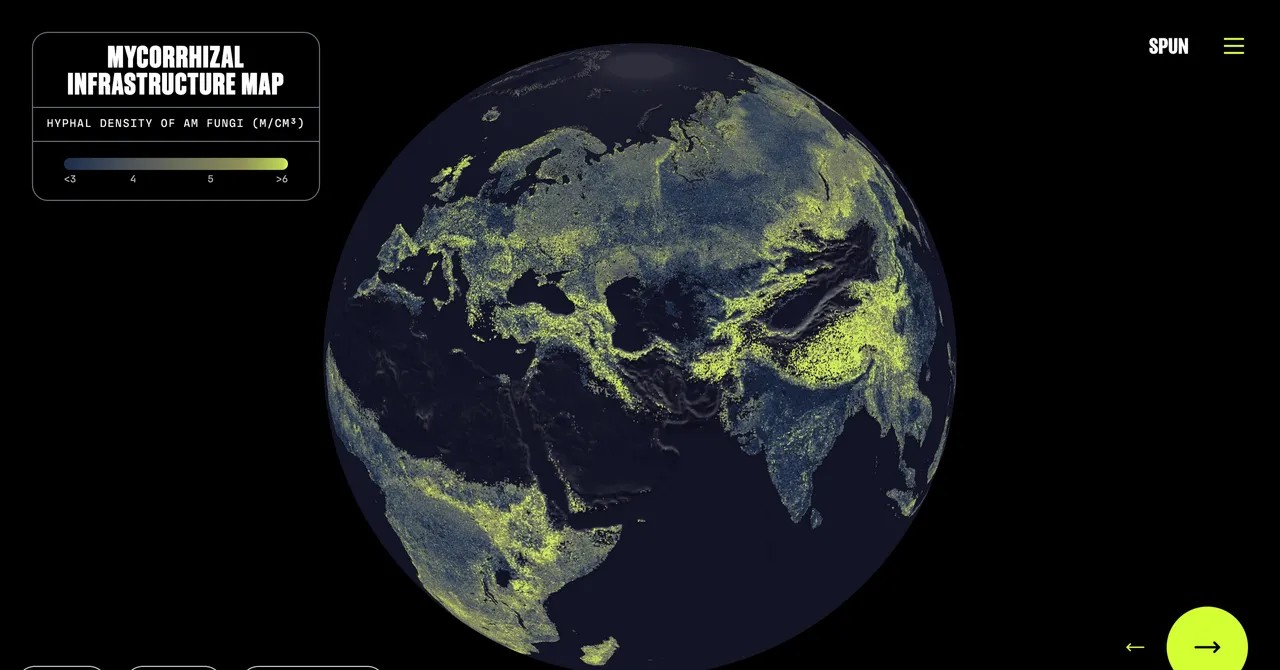
There is a web beneath you. Not spiders. Fungi.
An international team has mapped it. The first time, ever. This is the mycorrhizal network. A planet-sized partnership between fungi and plants. They publish in Science. The number?
110 quadrillion kilometers.
You can’t picture it. Try again. It’s nearly one billion times the distance to the sun.
What Lives Below
These are arbuscular mycorrhizal fungi. They feed roots. Roots feed them. It is a trade. Water, nutrients for carbon. Microscopic threads, called hyphae, stitch it together.
Do plants need this? Mostly yes.
About 70% of plant species survive only because of these fungal ties. Without them? Most of the green world collapses. They also regulate the climate. Quietly. Constantly.
Seeing the Unseen
Last year, someone looked at fungal diversity in Nature. Good data. But no map. No density numbers. Just patterns.
This team fixed that.
They took 322 old studies. They analyzed 16,000 soil samples. Then they used machine learning. And robotics. High-resolution imaging helps you see what you missed before.
Corentin Bisot says we are finally revealing what stays hidden under our boots. He’s right. We only see the trees. Never the wiring.
Heavy Weight
Here is the biomass. Roughly 300 megatons of carbon.
How heavy is that? Imagine all the living humans on Earth. Multiply their total mass by five. By six. That is the weight of these fungi.
They move carbon too. Around 4 billion metric tons of CO2 enter the soil each year thanks to them. That is 11% of human-caused emissions.
Justin Stewart, lead author, calls it a planetary circulatory system. A single teaspoon of soil? Up to 10 meters of network inside it.
We barely know what’s under us.
The Warning Sign
Agricultural soil has a problem. Its fungal density is only half of natural ecosystems. Half.
Grasslands hold 40% of this biomass. We are ripping them out. Turning them into farmland four times faster than we cut down forests.
Why does it matter?
Thinner networks mean less carbon storage. Less nutrient recycling. You break the loop. The soil starves.
Merlin Sheldrake puts it bluntly. These fungi shaped life for millions of years. We still don’t know where they live. Now we have a start. Maybe we can fix food security. Maybe climate change.
Or maybe we’ll keep paving it over.
The map exists now. What you do with it depends on how much you value the dark places.
“It is difficult to overstate the important scale of these fungi.”
Related reads
- The ‘Parasite of Paras’ Discovered in Borneo 🍄
- Satellite Views of Venezuela’s Quake Damage 📉
- Venezuela’s Seismic Doublet: Why It Hurts More 🇻🇪
- New Axolotl Fossil Found in Mexico 🦎
- Wind-Powered Data Center Goes Underwater in China 💨
- Antarctica Loses Winter Ice 🧊
- Repeating Radio Signals from Space Identified 📡
- Norway Scores, Bergen Shakes ⚽📢