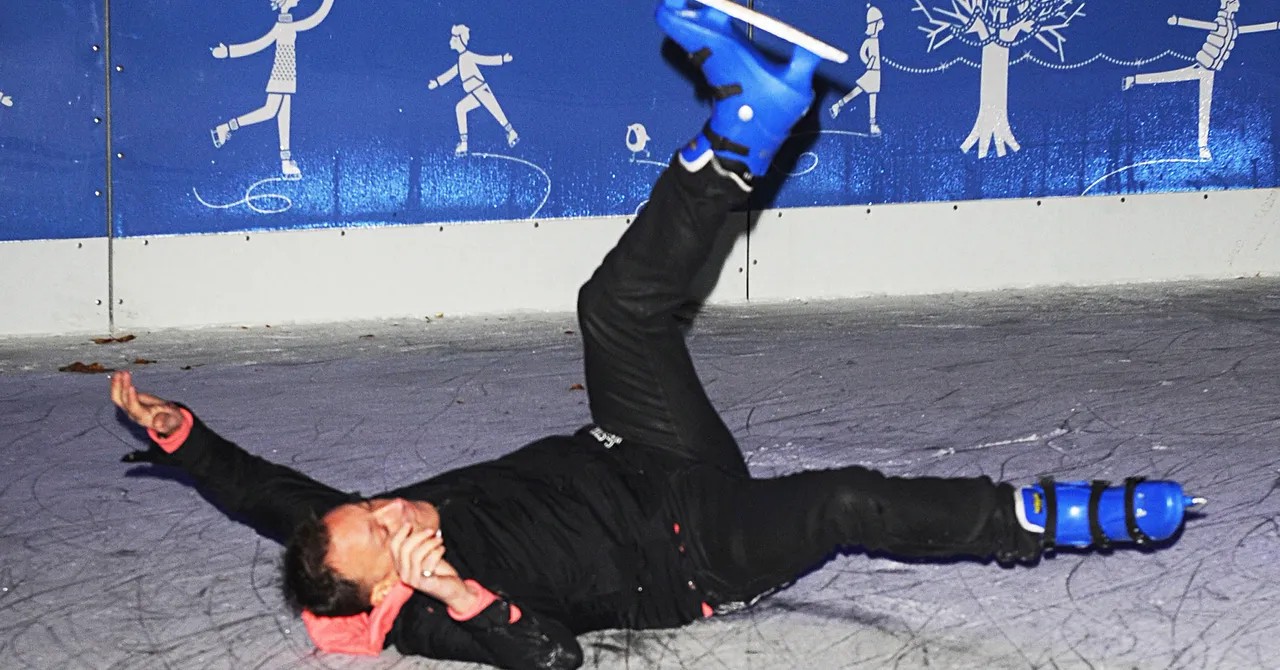
For over two centuries, scientists have debated the surprisingly complex reason why ice is slippery. While the presence of a thin water layer on the surface is universally accepted as the key to gliding or stumbling on frozen surfaces, why that layer forms remains a point of contention. Recent research suggests the answer may not be a single mechanism, but a combination of factors—or something entirely new we haven’t yet fully understood.
The Long-Standing Theories
The earliest explanation, dating back to the mid-1800s, proposed that pressure from weight or movement lowers ice’s melting point, creating a lubricating water film. Though supported by experimental data, this theory was later challenged when calculations showed typical human weight or skiing speeds exert insufficient pressure for significant melting.
A second hypothesis pointed to frictional heating. Rubbing against ice generates heat, melting the surface. However, this explanation fails to account for immediate slipperiness: ice feels slick even before movement begins. Moreover, studies show that materials that conduct heat well reduce slipperiness, contradicting the idea that heat alone is responsible.
The third major theory involves surface premelting : the existence of a naturally thin layer of liquid water on ice, even below freezing. This layer is thought to form because surface molecules are less tightly bound than those within the bulk ice, making them more mobile. The problem: while widely accepted, its role in slipperiness remains debated.
The Latest Breakthrough: Amorphization
Recent research from Saarland University suggests that none of the above theories fully explain the phenomenon. Instead, they propose a process called amorphization. This involves mechanically disrupting the ordered crystal structure of ice through sliding, creating a disordered, liquid-like layer.
Experiments show that even at extremely low temperatures, where melting is minimal, ice remains slippery. This suggests that structural changes—not just temperature-driven melting—are at play. The team’s simulations indicate that sliding forces deform the ice’s surface, creating an amorphous layer that thickens with continued movement. This deformation is particularly pronounced when materials with strong attraction to water slide across the ice.
The Path Forward: A Combined Approach
The current consensus among researchers is shifting toward a combined understanding: pressure, friction, and premelting all contribute to some degree. However, the discovery of amorphization highlights the possibility that mechanical disruption plays a crucial role, especially in colder conditions.
The lingering disagreement may stem from differing terminology and a reluctance to openly debate conflicting viewpoints within the scientific community. As Daniel Bonn, a physicist at the University of Amsterdam, notes, “The fact that ice researchers do have different and contradictory opinions, but they don’t really tell each other that they disagree with each other” may be hindering progress.
Ultimately, the slippery mystery of ice appears to be resolving. A holistic understanding that incorporates mechanical deformation alongside thermal effects will likely provide the most accurate explanation.