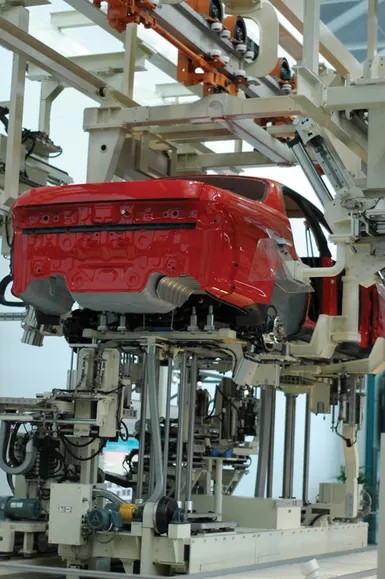
Look at the assembly line. It’s not all metal and noise. This is a carefully planned change process. Includes resources. Value exits. The gap between the two is where the real work happens.
In the broadest sense, any production system is a machine that consumes raw materials and produces useful products and services. Economists have a special term for this. They call the inputs “factors of production”. Usually this means labor, capital and land. The production manager may have a slightly different opinion. They prefer the “5 M’s”: people, machines, methods, materials and money. It’s the same concept. The terminology is different. The conclusion is the same.
Flow of materials and information
You can’t just throw resources together and wait for a product. You need flow. There are actually two types.
First, the material flow. It is a material that has gone through an intermediate stage. In progress. Finished product. Travel from station to station. The speed and amount of this flow is limited by the capacity of your system. If the bottleneck is too narrow, production will decrease.
Then there is the flow of information. Paperwork. Data. Instructions. This channel runs parallel to physical goods. It contains instructions that tell the machine what to do. When the information path breaks, the physical flow also stops.
The manager’s job is to manage this dual process. In planning. control. Ensure that the system meets the performance objectives. It’s not just about doing things. This is to make it predictable.
Quality as a constraint
Capacity sets the ceiling on volume. But quality determines value.
Products are more than just objects. This is a set of features. Appearance. Performance. Durability. Serviceability. timeliness. Cost. The appropriateness of the documentation.
All these factors influence the definition of quality. If the production targets are met, but the product is defective, late or poorly documented, the system is broken. Quality is not an afterthought. This is a limiting factor. This limits the number of results that the system can report as successful.
Batch production system
Not all products are created equal. There are three basic types of production systems. Batch processing system. The continuous system. project system.
First, let’s look at batch processing systems. Also called a job shop. Here, general-purpose equipment handles small batches. The technical data varies from batch to batch. Today you might build a set of special tools. Tomorrow, you switch to a heavy construction machine. or special chemicals. Or processed foods.
The processing of insurance claims works in the same way in the service sector. One batch of claims. Then another. The total is shown immediately at the end of the period. It is flexible. It is very versatile. However, it is not designed to mass uniformity.
The continuous system? That’s a whole different beast. High volume. Standardized products. Consider oil refining. Or car stamping. But that’s a story for the next section.
Continuous production mechanism
Continuous production is the industrial engine behind everything you touch every day. In this system, objects move according to a fixed sequence of actions. These steps are standardized. They apply to the majority of products passing through the factory. The goal is quantity. Massive throughput.
To achieve this, the company invests in special equipment. They design methods to reduce production costs. Efficiency is not just nice to have. This is the main goal. When you look at your television, washing machine or computer, you are probably looking at the output of a continuous assembly line. Automobile engines are another prime example. Although the process is more complex, it has been streamlined.
Division of tasks
In these systems, labor is fragmented. Tasks are divided into smaller, more manageable parts. Employees do not build entire products from scratch. They master one specific action. They perform it quickly. They repeat it effectively. This division of labor increases speed. It reduces the time needed for training. Minimize errors.
This approach is common in large manufacturing operations. The term “assembly line system” is often used interchangeably with continuous production. But there is a difference. The assembly line is the mechanism. Continuous production is a strategy.
Why cost and scale matter
The true power of continuous production is economies of scale. The more you make, the cheaper each unit costs. This makes consumer goods affordable. The fixed costs are spread over millions of units. Repetition minimizes variable costs.
This system is not without risk. A large initial investment is required. It demands precise coordination. If any step fails, the entire production line stops. However, for products with stable demand, the benefits outweigh the costs. The result is a consistent supply of goods. At a price that the market can bear.
One-time model: Managing Singular Projects
While batch lines and continuous lines often work together, there is a third beast altogether. It’s a Project System, or what the industry calls a “one-shot” model.
Imagine a skyscraper. Or a supertanker. Or the first prototype of a new fighter jet. These objects do not roll off the belt at predictable intervals. They are singular entities. Unique.
In this case, there is no fixed line waiting for parts. You bring the resources together for a single event. When the project is finished, the resources are disperse. This singular nature can create a management nightmare if you’re not careful. Costs can spiral. The Scope can creep.
Therefore, special control techniques have been developed to prevent these massive, one-off productions from derailing. Without strict oversight, “one-off” projects are just black holes for capital. Our goal is not efficiency in the traditional sense. This is containment. There has to be a way to keep costs down while dealing with the unpredictability of building something that has never been built before.
The alternative is clear. You sacrifice the lower unit costs of mass production for a fully customized product. However, this customization comes at a cost and requires strict monitoring to justify it.
Why vehicle assembly plants are still important
The Vehicle Assembly Building (VAB) at Kennedy Space Center in Florida is more than just big. It’s ridiculously big. It is one of the largest structures in the country, storing approximately 3.7 million cubic meters of air. That’s about 130 million cubic feet. You can even include the entire Statue of Liberty and a few more skyscrapers.
The VAB was originally designed for the Apollo-Saturn V rocket and was later applied to the space shuttle program. Let’s take Atlantis as an example. Orbiter hangs here before launch. It waits in the dark, cooling and preparing, until the time comes for the external fuel tank and solid fuel rocket booster to arrive. Then the assembly begins.
This is not just a warehouse. This is the place of the star factory. Engineers work inside the walls of these gigantic caverns, building machines that defy gravity. It’s hard to get scale unless you’re standing inside. The door itself is taller than the Empire State Building is wide.
Some may wonder why such extensive infrastructure is still needed. The answer lies in the large size of modern launch vehicles. You can’t build a rocket in your garage. Vertical integration is required. Requires height. Space is needed.
VAB offers all three functions. Yes, this is a relic of the Cold War. But it is also a work tool. It continues to prepare for the next era of spaceflight. Whether it’s commercial cargo or a lunar module, the building’s purpose is the same: assembly. test. release.
There is something almost poetic about buildings built for one purpose and supporting another. Saturn V is long gone. The space shuttle has been retired. But VAB remains. Silence. hold on
I don’t care about the budget. It is apolitical. It just takes up space. There is a sense of stability in this silence. A reminder that some things exceed plans.